
Beta vulgaris
Sugarbeet
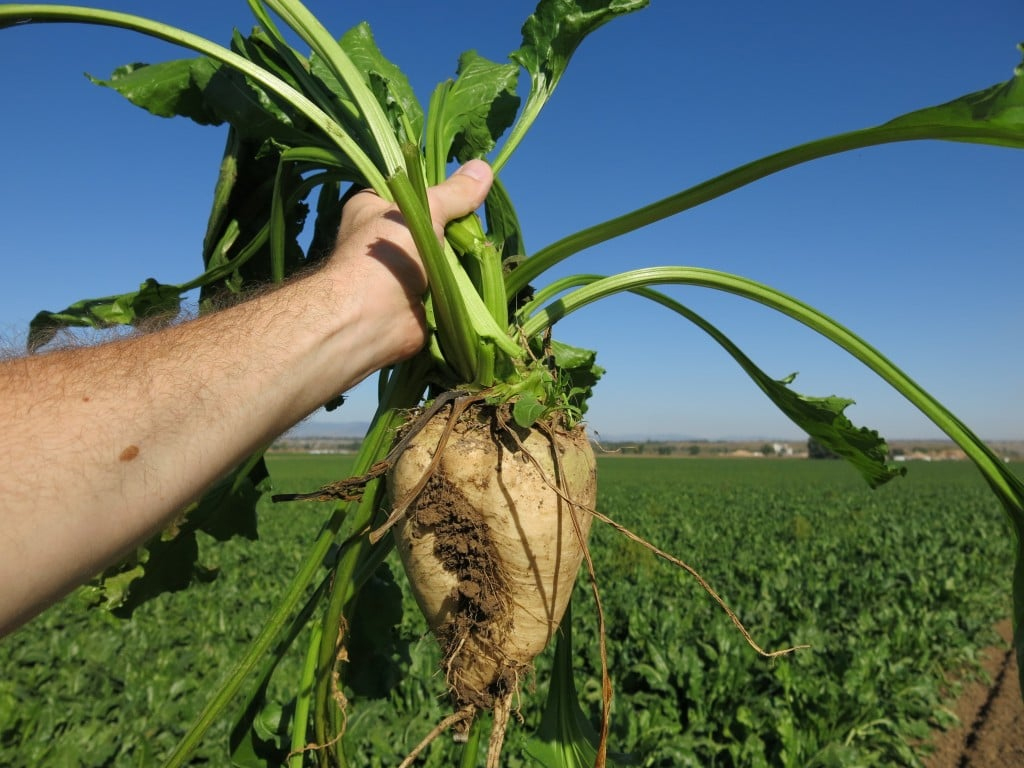
A sugar beet is a plant whose root contains a high concentration of sucrose and is grown commercially for sugar production. In plant breeding, it is known as the Altissima cultivar group of the common beet (Beta vulgaris) Together with other beet cultivars, such as beetroot and chard, it belongs to the subspecies Beta vulgaris subsp. vulgaris but is classified as var. saccharifera. Its closest wild relative is the sea beet (Beta vulgaris subsp. maritima).
Sugar beets are grown in climates that are too cold for sugarcane. In 2024, Russia and Germany were the two largest sugar beet producers contributing to a world total of 294 million tonnes Sugarcane accounts for most of the rest of sugar produced globally.

SUGAR BEET – a long post about a misunderstood crop …
So the other day, I posted about Sugar Beet and given all the bad press that Sugar gets, I thought that we would add a bit of background about this misunderstood crop, with some info supplied by Andy, and some together with the stats from an excellent article by Suzy Stennett in Suffolk and Norfolk Life Magazine (Sept 2019)
Despite the scary 2017 statistic that 6 IN 10 ADULTS HAD NO IDEA THAT SUGAR IS GROWN IN GREAT BRITAIN! (and there was even a Twitter exchange between a farmer and a Supermarket Customer Service Dept about it), the UK Sugar Beet industry is actually over 100 years old.
There are over 3000 British Farmers who are currently contracted to grow some 8 million tonnes of sugar beet over an estimated 107k hectares of land – mostly in East Anglia. Up to 1.5 million tonnes of sugar is processed annually and this helps support approximately 9500 jobs in the rural economy. Our family farm has been growing sugar beet since the 1920’s – and continuously since 1933, so we do have some experience!
Sugar Beet Plants convert the sun’s energy into sugar using photosynthesis (which I am sure you remember from school days!) and have the greatest sugar content of all plants at 16%. It has a naturally occurring formation which means that the sugar extracted from sugar beet is identical to the sugar found when you bite into fruit and vegetables. The sugar is stored in the roots.
People are often confused about where their sugar comes from as it can come from sugar cane which is grown in hotter climates, semi refined in the country of origin and shipped into the country of use to be further refined. Sugar Cane has a 14% sugar content and was the original source of sugar discovered about 5000 years ago by the Polynesians. It took until 1747 for sugar beet to be identified as a sugar source – and by 1880 had replaced cane as the main source of sugar in Europe. It is commercially grown in a number of countries, and over 100 countries produce a total of 180 million tonnes of sugar each year.
The UK’s annual demand for sugar is currently around 2 million tonnes: 50% is supplied through British Sugar (Silver Spoon); 25% from EU sugar beet processors and 25% comes from imported cane sugar (imported raw, then finished, packaged and supplied by Tate and Lyle in London)
British Sugar is the sole processor of the UK’s sugar beet crop and works in partnership with all their growers – this collaboration started in 1912 when the first processing factory was opened in Cantley. There are just four processing plants now, Cantley along with Wissington (where ours goes) in Norfolk, Bury St Edmunds in Suffolk (my navigational milestone from my BSE days!) and Newark in Nottingham – many of the smaller factories, like ours in Spalding (the aroma was very much “love it to hate it”, but we thought it was a lovely, rich, malty smell) have been closed. Sugar Beet also boasts really low food mileage – on average, the harvested crop travels just 28 miles to the processing plant.
So on our farm as on most, the season story starts around March when the conditions (weather and soil temperature) are right. A tonnage agreement is pre-set with British Sugar and the fields are drilled (sown) with beet using the imaginatively named “beet drill” – around 110-125k seeds per hectare are drilled. Hopefully the weather will be kind – no frosts to kill the seedlings, no strong winds which can whip out the young seedlings or heavy rains which create too hard a soil crust for the seedlings to break through – ideally it will be sunny and showery so that by July there is a good crop in the field. They continue to grow and increase in yield until the soil cools.
The “Sugar Beet Campaign” starts around September and the four processing plants are opened – and so begins a huge, logistical operation to ensure that all the harvested beet gets to the factories before the end of February when the processing plants are closed. The beet has to be evenly distributed across the sites and this is done via permits. Farmers have to consider all the pros and cons, as with any harvest – harvest too early and the yield may be lower, harvest too late and it may be frozen into the ground and cause problems with the machinery – many farmers hedge this by harvesting in more than one load, one before Christmas and one early in the new year. Modern harvesters are HUGE – and weigh up to 50 tonnes. Due to the expense, and the difficulties in harvesting, many farmers have a contractor do the harvesting for them – we have Richard to do ours, and Jason carts the loads to Wissington.
Once at the factory, it is washed and sliced and immersed to extract the sugar which is used to create a whole range of sugar products and types for the commercial and retail markets. The processing factories are all virtually zero waste, sell electricity generated to the grid, reuse any stones found in with the beet for civil engineering and reuse the soil for landscaping and other industries. Waste beet pulp is used for animal feed and the heat and light of the processing plants are also used as a by product for other crops which have included medical use cannabis.
Sugar gets a bad press, but has always been a part of a balanced human diet and has 4 calories per gram. Beet and Cane sugar are functionally and chemically identical, utilised in the same way by our bodies. But only one of them is grown and processed in the UK and not imported from the other side of the world!
Recently, in a discussion about Sugar Beet and Pesticdes/Seed Dressings (please see our subsequent post on 5 March – which addresses these issues) we had these questions put to us:
Q “Do we even need this much highly refined sugar? The Govt are trying to reduce the amounts of sugar we eat. Diabetes caused principally by refined sugar intake is at record highs. We use what say 100,000 hectares of prime arable land to grow so sugar beet using harmful chemicals, more sugar than we ever will need. This is a crop we can mostly do without, or at least reduce by two thirds, that is likely to be causing harm to ecosystems, not to mention the impact on the soil itself. I think we can do better for farming and society, and wildlife and the ecosystems they live”
Obviously, this was within a wider ranging discussion addressed at the time and in the other post, but it raised an opinion to which we responded:
A: “Whilst the sugar intake discussion is different to that of pesticide use, the farmers are not the ones marketing or adding it to people’s diets. Clearly, the population is not going to stop consuming, or drastically reduce using sugar any time soon – and so if UK farmers stopped growing it, then the only alternatives are chemical sweeteners (worse) or sugar cane which is imported. Not sure about the green credentials of cane, as a) food miles involved in transporting it halfway around the world and b) the countries it is grown in have far fewer regulations on pesticide use, and indeed on their workers’ conditions (Stronger Together – who work to abolish Modern Slavery – do much work here, I go on their seminars and courses through work). The average food miles for sugar beet grown in the UK is 28 miles, and the factories are all zero waste – ie all electricity generated is used or sold back to the grid, any stones and soil are reused and the pulp is used for animal feed.
This page is sponsored by:-

WA PEARCE & SONS FARMS
Download free QR Code to this page